
Tech
AI-Powered Web Design: Why Your Human Touch Is More Valuable Than Ever

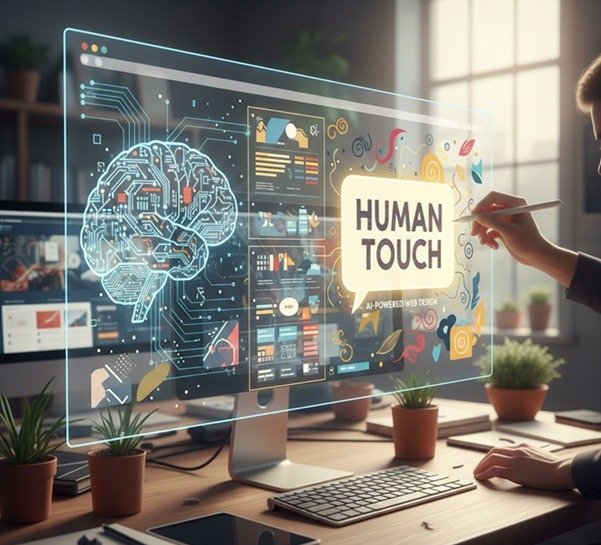
Artificial intelligence technology is transforming the landscape of website development. Whether it is a wireframe or content written by artificial intelligence, everything keeps improving by the day. What you should understand is that not all websites are created equal. The best sites are not those that are created quickly by technology.
AI is revolutionizing the art of designing websites by making it possible for them to be automatically generated and cater to unprecedented levels of customization. However, this has also heightened the importance of human-oriented user experience strategies, which are now more important than before due to the onset of AI-driven automation.
In this article, we will examine the conflict at the heart of today’s web design: how to channel the power of AI without sacrificing the human element that keeps people attached to the website. Let’s get started.
What Does “Designing Websites in the Age of AI” Actually Mean?
Website design in the age of AI is not only incorporating automation and machine learning and generative technologies but also the human side of UX. The execution is done by AI and the meaning is defined by humans.
How Is AI Currently Used in Website Design and Development?
Artificial intelligence is a major part of web workflows today. Fast AI website builders like Wix ADI and Framer AI can produce the entire layout with just a few prompts. Automated wireframing tools have become designers’ choice for generating various layout options in a fraction of the time it used to take.
On the programming side, AI can produce HTML, CSS, or React components just from a prompt or a design file. The way to content has also been transformed writing, images, small brand elements, and even micro interactions can be done in almost no time.
These are strong tools. But strength without purpose leads to lack of variety.
What Is the Difference Between AI-First Design and Human-Centered Design?
AI-first design means that the main features that are considered are speed, scale, and optimization. It answers questions like: What layout converts best on average? or Which headline performs better across large datasets?
Human-centered design asks different questions: Do users feel understood? Is this experience accessible, trustworthy, and emotionally clear? Does it reflect the values of the brand behind it?
Artificial intelligence is to be used as a tool for UX decision making not as a replacement. When designers are in charge and AI is a tool, websites are both user friendly and highly efficient.
What Are the Real Benefits of Using AI in Modern Website Design?
Simply put – AI when used in a web design strategy, enhances the productivity of the design team, the level of customized user experience, the site usability, and its overall performance. These are the areas where the technology really gets into its stride.
How Does AI Increase Efficiency for Designers and Developers?
AI is highly effective in task automation, especially in the case of repetitive tasks. Within moments, one can have a wireframe, a responsive layout, or a boilerplate code generated. This means that the work of designers is not to come up with a solution out of the blue but rather to build on an existing concept.
An AI-driven design tool can accomplish the task of wireframing within a very short time, thereby letting you handle the decision, making that requires your creativity and judgment.
The math is simple: Less time working on the dull side of the job and more time on the strategic and the refining part of the work.
How Does AI Enable Dynamic and Personalized User Experiences?
Personalization was a pricey undertaking a long time ago. Now, with the help of machine learning, predictive design, and adaptive layouts, you can offer different user experiences to various users at the same time and in real time.
A loyal customer may be greeted with a different homepage layout than a customer who is coming for the first time. The content can be changed based on the user’s behavior, their preferences or even the device they are using.
If predictive UX is put into practice with caution, then it has the power to increase conversion rates. The users are of the opinion that the experience was tailored for them because that is exactly what happened.
How Can AI Improve Website Accessibility?
Artificial intelligence can be very helpful in making a website accessible to all users. Some of such ways include producing alternative text, translating different languages and carrying on automated WCAG audits. The implemented features to a large extent can lessen obstacles for numerous users.
Nevertheless, the accessibility errors that can be made without a human review are still there. Artificial intelligence might not be able to understand the context, tone or even the cultural nuance, and that is the reason why UX testing for an inclusive community is still very important.
Will AI Replace Web Designers or Change Their Role?
The use of artificial intelligence will not be the reason web designers lose their jobs; rather, it is changing them into the tactical coordinators of tools, prompts, and experience.
What skills should web designers possess in this age of AI technology?
Technical design abilities remain essential, but their focus is shifting.
- Prompt design skills are set to become a crucial skillset as a result. The key to getting good output from AI models lies in being able to express what you want clearly and effectively in written form. It is a new language that designers must master.
- UX strategies and research are what differentiate better designers from best designers. User interviews, user testing, and analysis give you what users actually want. AI can’t do this.
- Bias awareness and ethics are not negotiable. As an AI developer, you should be aware of the role of the training data used to generate the AI outcomes and learn how to identify and correct for biases.
- Performance knowledge is now more relevant than ever. It’s critical to not only learn about Core Web Vitals and image optimization but also know the effects that third-party resources may have.
What Is an “AI-Orchestrated” Web
An AI-orchestrated designer sets intent, constraints, and quality standards. AI executes at scale. The collaboration is clear: the web designer collaborates with AI assistants, not the other way around.
Are AI, Built Websites Too Generic or Cookie, Cutter?
AI, built websites may seem like a standard unless the designers deliberately decide to structure, write the content and show the brand.
Why Do Many AI Websites Look the Same?
Templates keep being reused. Models are trained on existing patterns. Optimization chooses averages most of the time. The outcome? Websites that work great but lack the wow factor.
How Can Brands Still Be Unique When They Use AI Tools?
The solution is human inventiveness and purposeful use.
Utilize custom prompts that define your brand’s voice and values. Do not depend on standard defaults. Create a design system that mirrors your brand and then employ AI for the consistent implementation. Do the writing on your own or hire a professional copywriter, don’t let AI take over your entire communication. Personally, edit those generic, layouts and microcopies. Small changes in wording, adding or removing space, or highlighting visually can turn a template into your unique one.
Your brand’s authenticity is something AI can’t generate. It has to come from you.
How Does AI Impact Website SEO and Visibility in Generative Search?
Search Engine Optimization (SEO) is undergoing a transformation. It is not dying – just changing.
What Is Generative Engine Optimization (GEO)?
GEO is a step beyond traditional SEO. It adjusts the content to be found by AI, operated search engines such as ChatGPT, Gemini, and Googles SGE through features like being more understandable, trustworthy, and well, organized.
How Should Websites Be Structured for AI Crawlers?
This is a bit technical, but it should not be overlooked. Apply JSON, LD schema markup to point out the main focus of your content. Schema types like Software Application or HowTo serve as examples whereby the AI models get the context.
Throughout your website, have the most straightforward entity, attribute relationships for example, if you are a SaaS company, clearly state what your product is, who it is for, and what kind of problems it solves.
Internal linking is getting more and more valuable.
AI models utilize links to figure out the relation between ideas and thus form knowledge graphs. Through an efficiently organized internal linking plan, AI models get the framework to situate your content.
How Does EEAT Refer to AI, Generated Content?
EEAT is an acronym for Experience, Expertise, Authoritativeness, and Trustworthiness. It is a factor that matters a lot when AI is used.
If you have AI-assisted content, then it should be checked by a human expert. Showcase your real life experience and expertise by yourself rather than by AI. Search engines reward honesty as well as readers. If you used AI as a means, then state it. If your content is free of AI, i.e. 100% human writing, then use it as your advantage.
What Are the Ethical and Legal Risks of AI in Web Design?
Through AI – copyright, privacy, accessibility, and bias issues arise, which require the intervention of a human.
Who Owns AI, Generated Website Designs and Content?
There is still significant ambiguity in copyright law. Since most of the tools have different licensing terms, it is important to be reviewed by a human and be aware of the legal side of the matter.
How Can AI Introduce Bias Into UX Design?
The training data it gets is already biased. If there is no inclusion in testing, those who are not considered users of the AI-driven UX may unintentionally be left out.
What Privacy Concerns Come With AI Personalization?
To be personalized, one needs behavioral data. Consent, transparency, and following the regulations like GDPR and CCPA are still the main things that need to be in place.
How Does AI Affect Website Performance and Core Web Vitals?
How you deploy AI determines whether it enhances or diminishes your site’s performance.
How Can AI Optimize Images and Assets?
On the positive side, AI excels at optimization. Modern image formats like WebP and AVIF dramatically reduce file sizes without sacrificing quality. Smart resizing ensures you’re not serving oversized images to mobile users, while lazy loading delivers visuals only when they’re about to enter the viewport.
These performance improvements directly affect page speed, mobile usability, and search visibility, all of which play a critical role in mobile-first indexing. When your site loads quickly and adapts seamlessly to smaller screens, you’re not just improving user experience; you’re also aligning with how search engines evaluate and rank your content today.
Can AI Scripts Hurt LCP and Page Speed?
Just like that, a site can be weighed down by a plethora of third-party AI scripts. Precisely measuring the effect on the website is what matters the most, a site in good condition should have an LCP of less than 2.5 seconds.
What Is the ROI of Using AI in Website Design and Development?
This is the question of the business. Does AI really lead to a reduction in expenses and the creation of more efficient websites?
The response: only in some cases and it is dependent on your objectives.
Are AI Web Design Tools Less Expensive than a Web Designer?
Yes, in the short term. With the help of AI, a website can be created within a few minutes which costs far less than the hourly rate of a web designer. However, the situation gets complicated as time goes on. If the website made by AI does not attract visitors, hurts the trust of users, or is required to be constantly changed because it does not recognize your brand or the needs of your users, then the money you saved disappears.
The real cost is lost revenue, lost credibility, and the time spent fixing what was done incorrectly by the automation.
When Does AI Deliver the Highest ROI?
AI is a star performer only in certain scenarios.
- Prototyping and MVPs: Have to prove a point fast? AI generated wireframes and layouts make it possible to try out your idea way faster than if you were to follow the traditional design route. If the idea turns out to be viable, then you can definitely make the quality handoff to your design and development team.
- Content scaling: In case you are requiring product descriptions in the hundreds or variations of a landing page for A/B testing, then AI assisted content generation is definitely the method that will save you a lot of time. You are the one to check and polish, but the groundwork is done automatically.
- Optimization and experimentation: With the help of AI, you are able to carry out tests on a large scale; for instance, you can have different headlines, layouts, or CTAs for comparison purposes and later check which ones are the most effective. The insights you draw are authentic, and the cost is much lower than if you were doing the testing manually.
ROI is at its peak when the use of AI is combined with what it does best: speed, scale, and variation. Humans on the other hand, should be employed for what is the most important: strategy, judgment, and authentic connection.
What Does the Future of Human, Centered Web Design Look Like in an AI World?
What will be the standard of excellent web design five years from now?
Conversational interfaces won’t be an innovation anymore but a norm. You will be chatting with your website rather than clicking buttons. Adaptive layouts won’t be restricted to the device anymore, as they will depend on the context and user preference as well. Brands using AI- driven UX to experiment will be able to constantly test and learn, guided by data for design decisions.
But here’s what won’t change: the need for designers who understand people.
Why Will Human Judgment Matter More, Not Less?
Trust, emotion, and authenticity are things that cannot be taken over by robots. Those pieces of content that score high in authenticity will be verified by humans and assisted by AI not entirely produced by a machine.
Conclusion: Why Human, Centered Design Is the Competitive Advantage in the Age of AI
AI should be seen as a multiplier rather than a replacement. It either magnifies what is already there the good or the bad. If combined with strong UX strategy, ethical thinking, and human empathy, it turns into a great social force.
Trust becomes the new currency in a world driven by AI. Sites that appear human, reachable, and deliberate will be the winners. The next chapter of web design is not about humans versus machines but rather about designing for people with AI as a thoughtful partner.
Your human judgment is your edge. Never outsource that.












Leadership Transformation in Modern Business: Moving Beyond Traditional Coaching

Homeowners: What to Look for When Choosing a Reliable Ac Repair Company in Las Vegas

Pregnant Women: Key Considerations When Seeking a Webster Technique Chiropractor

Scholarly Stars – 6 Surefire Keys To Successful Studies

Kitchen Kit-Up – The 6 Indispensable Items You Need To Get Your Kitchen Ready For Action

Exeter’s Student Housing Scene Is Expanding – What 2026 Students Should Know

How Historic Architecture Boosts Real Estate Value

Why Understanding Party Wall Agreements in Essex Is Important Before Building

Innovative Strategies for Engaging First-Grade Students in the Classroom

The Hidden Fees Eating Your Crypto Portfolio (And How to Avoid Them)

100 Motivational Quotes to Inspire You in 2026

100 Motivational Quotes to Start Your Day with Positivity

22 Best Self-Help Books to Read in 2026

How to Create a Vision Board That Actually Works (2026)

Changing Your Spending Habits

Top 50 Motivational Quotes for Success and Hard Work

How to Achieve Personal Growth in 2026

New Year Wishes and Quotes to Inspire and Celebrate (2026)

Do I Have to Pay a Debt That’s Very Old?

5 Excellent Reasons for a Healthcare Provider to Utilise the Services of a Nursing Agency
-

 Motivation5 years ago
4 Fun New Hobbies To Try This Year
-

 Quotes3 years ago
53 Motivational Gym Quotes to Fuel Your Workout
-

 Travel1 year ago
Why You Should Travel More: The Many Benefits of Seeing the World
-

 Quotes10 years ago
50 Most Powerful Quotes Ever Spoken
-
 Quotes3 months ago
100 Motivational Quotes to Inspire You in 2026
-

 Quotes2 years ago
43 Inspirational Quotes About Thoughts
-

 Quotes3 years ago
105 Motivational Quotes by Famous People
-
 Quotes9 months ago
100 Motivational Quotes to Start Your Day with Positivity