
Lifestyle
Air Fryer Wattage, Capacity And Features: A No-Nonsense Breakdown For First-Time Buyers

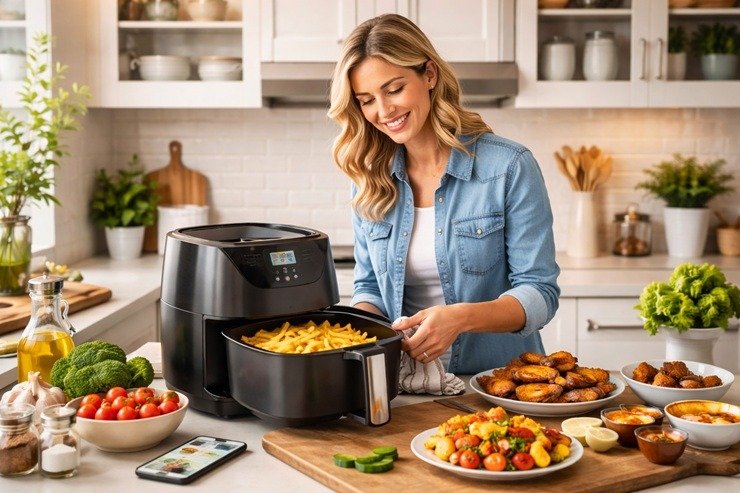
So, you have finally made up your mind to buy one. Maybe your colleague just won’t stop raving about how she makes bhindi in twelve minutes, or you have seen too many videos of perfectly golden fries falling out of a basket. Whatever it is, you are here now, looking at a screen filled with different air fryers, all of them looking more or less the same, yet priced at vastly different rates. Welcome to this particular kind of confusion.
It’s more complicated than it needs to be. And most of it comes from specs that nobody explains properly. Let’s fix that.
Wattage: Honestly, Pay Attention to This One
Most people don’t. They look at size, colour, brand, price, and wattage, which ends up being the number they scroll past without a second thought. Which is fine, until the appliance arrives and food keeps coming out half-cooked on one side.
Here’s what’s actually happening. Wattage determines how fast the air fryer heats up, sure, but more than that, it determines how quickly it recovers heat when you disturb the cooking environment. Open the basket mid-cook to shake your fries, which you’re supposed to do, and a weak motor just… loses the temperature. It takes a while to climb back up. By then, your food has been sitting in lukewarm air for thirty seconds, and the crisping stops.
For a normal Indian home, 1200 to 1800 watts is what actually makes sense. Less than 1000 watts, you are literally paying for an air fryer that just rehydrates leftovers with extra steps. More than 1800 watts, you are usually looking at a larger model that uses more watts per use case and requires significantly more counter space.
One thing nobody ever mentions: if you live in an older apartment, check what your circuit can handle before ordering something near the top of that wattage range. Not trying to alarm you, it’s just a two-minute check that saves a trip to the electrician later.
Capacity Gets Misunderstood More Than Any Other Specification
Bigger feels safer. That’s the instinct. And honestly, it’s the wrong way to think about this.
An air fryer works because hot air moves around food constantly and rapidly on all sides. If you put insufficient food in a large basket, hot air simply moves around empty space. It doesn’t work like this. If you have two chicken pieces in a 6-litre air fryer, you will get a worse result than if you have two chicken pieces in a 3-litre air fryer.
So size to your household, not to your ambitions.
| Household Size | Recommended Capacity | Best For |
|---|---|---|
| 1 to 2 people | 2 to 3 litres | Daily snacks, reheating, small portions |
| 3 to 4 people | 4 to 5 litres | Full family meals, batch snacks |
| 5 or more | 6 litres and above | Larger batches, entertaining |
Buy the one that fits how you actually cook on a Tuesday, not how you imagine cooking on a Saturday when you have guests over.
The Feature List: Most of It Doesn’t Matter
Every product page makes it sound like you’re buying a small robot that will transform your relationship with food. Twelve preset modes. Touchscreen controls. Wi-Fi. A rotisserie spit. It goes on.
The things that genuinely change how your food turns out:
- Temperature: You need to have an 80°C low end and a 200°C minimum high end. Air fryers with a maximum temperature of 180°C will drive you nuts, and you’d think you’re crazy for even wanting one if you want to have a crust on what you’re frying.
- 60-minute timer with auto-shutoff: This is the floor, not a luxury. Anything shorter and you’ll be resetting the timer partway through anything that takes more than 30 minutes.
- Basket coating quality: Non-stick that actually holds up. Cheap coatings start flaking around the three-month mark with regular use. Unpleasant, and eventually a real concern.
- How well it comes apart for cleaning: A basket that doesn’t fully separate means grease building up in corners you can’t reach. You’ll notice it around week three.
Things you can skip without missing them:
- App control and Wi-Fi features. Great in theory, abandoned in practice within a few weeks.
- Preset programs beyond eight or ten. Manual mode ends up being where you spend most of your time anyway.
- Rotisserie attachments on anything under 5 litres. The clearance is genuinely too small to be useful.
Two Formats, Two Different Kinds of Cooks
Basket-style is what most people picture. Pull out the drawer, load your food, push it back in. Most compact 2 to 5 litre models follow this design. Easy to use, easy enough to clean, and genuinely fine for most households cooking everyday meals.
Oven-style opens from the front like a small countertop oven, has multiple racks, and handles larger volumes and more varied cooking. Baking, toasting, and multiple items at once on separate trays. Takes up more space and usually costs more. But if your household is regularly cooking three or four different things on a given evening, that extra versatility earns its place.
Both options are useful in their own ways. If you are undecided about which direction would suit your kitchen better, then a look through the air fryer collection on Borosil will provide you with a side-by-side comparison of what options are available in the market.
Conclusion
The first few uses will mess with you a little. That’s just true.
Food cooks much faster in an air fryer than the recipe from any conventional oven will indicate. Reduce the temperature by 10 to 15 degrees and the time by 20 percent in making any recipe, and still, keep an eye on it the first time through. Most first-time users will burn something and complain that the device is faulty. It is seldom the device.
And don’t pack it in the basket. Oh, it’s tempting if you’re hungry and in a hurry, but the whole point of the thing is that there needs to be room for the air to get around the food. If you pack it in there too tightly, you’re not frying it-you’re steaming it, which is okay if you really want it steamed, but probably not if you went to all the trouble of buying it.
Four or five uses in, something clicks. The timing becomes intuitive, the temperatures stop feeling like guesswork, and you start wondering why you spent so many evenings standing over a kadhai when this was sitting in a box on a warehouse shelf somewhere.














Moving to Spain from the U.S.: How to Get Started

8 Essential Skills for Managing a Growing Business

Top 5 Cloud Mining Platforms in 2026: A Guide to Passive Income Mining for $3,700

Simple Daily Habits for Better Spinal Health

Preventive Dental Care And Whole-Person Health: A Practical Guide

A Buyer’s Guide to Evaluating Knoxville, Tennessee Neighborhoods

How Structured Alarm Data Can Help Emergency Communication Centers Work More Efficiently

Digestive Changes During Cancer Treatment: What’s Normal, and What Helps

How AI Image Creators Are Changing Visual Content Creation

How to Plan International Gifts Without Last-Minute Stress

100 Motivational Quotes to Inspire You in 2026

How to Create a Vision Board That Actually Works (2026)

22 Best Self-Help Books to Read in 2026

How to Achieve Personal Growth in 2026

New Year Wishes and Quotes to Inspire and Celebrate (2026)

Loeb Smith reviews: Why Crypto Licensing Demands Patience, Structure, and Skepticism

Custom Cover Letter Generator: Create Tailored Letters in Minutes

How to Leverage Personal Development for Career Advancement

Top Fitness Coach Certification Programs for Aspiring Trainers

From Denver to Vail: Secrets, Snow, and Soul of the Rockies
-

 Motivation6 years ago
4 Fun New Hobbies To Try This Year
-

 Quotes4 years ago
53 Motivational Gym Quotes to Fuel Gym Workout
-

 Quotes11 years ago
50 Most Powerful Quotes Ever Spoken
-

 Travel2 years ago
Why You Should Travel More: The Many Benefits of Seeing the World
-
 Quotes9 months ago
100 Motivational Quotes to Inspire You in 2026
-

 Quotes2 years ago
43 Inspirational Quotes About Thoughts
-

 Quotes4 years ago
Motivational Quotes by Famous People
-

 Quotes1 year ago
100 Motivational Quotes to Start Your Day with Positivity