
Tech
Solar Dish Technology Explained: The Clean Energy System That Runs On Heat, Not Light

Most solar technology turns light into electricity directly. A silicon cell absorbs a photon, knocks an electron loose, current flows. Clean, silent, elegant. But there’s a ceiling — commercial silicon panels convert roughly 20–22% of incoming sunlight into usable power. The physics of photovoltaics sets that limit, and it doesn’t move much.
A solar dish takes a completely different approach. It doesn’t convert light into electricity at all. It converts sunlight into heat — intense, focused, concentrated heat — and then runs a heat engine. The efficiencies achieved by the best dish-Stirling systems have touched 29–31% under test conditions. That’s not a marginal improvement. It’s a different class of technology.
What a Solar Dish Actually Is
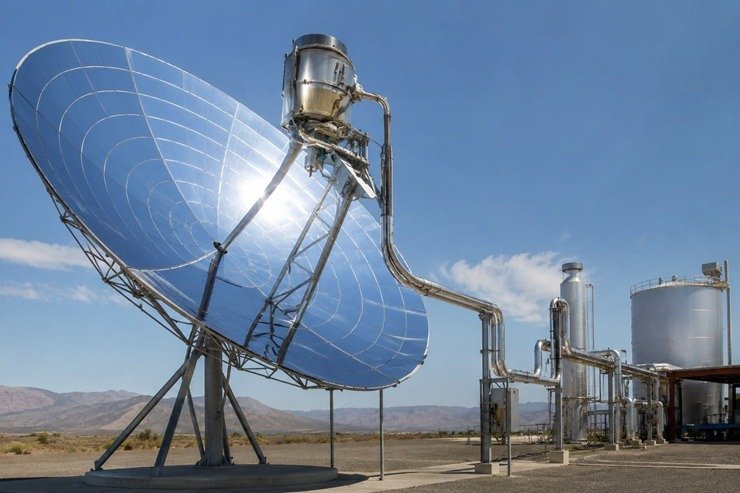
The concentrating part is a parabolic reflector — a dish, typically two to ten metres in diameter, covered in highly polished mirror segments. It tracks the sun on two axes throughout the day, keeping the focal point aimed precisely at a receiver mounted at the dish’s centre.
At that focal point, temperatures can exceed 700°C. Sometimes higher. The receiver absorbs that heat and transfers it to a working fluid or directly to a heat engine — most commonly a Stirling engine — mounted at the focus.
The Stirling engine is the part most people haven’t encountered. It’s a closed-cycle external combustion engine invented in 1816. Heat is applied to one end, a cold sink exists at the other, and the pressure differential drives a piston that turns a generator. No combustion inside the engine itself. No exhaust. Just a temperature gradient doing mechanical work.
The whole assembly — dish, receiver, Stirling engine, generator — is a self-contained power unit. Point it at the sun, it makes electricity. Move it away from the sun, it stops.
Why Concentration Changes Everything
A flat PV panel receives sunlight at roughly 1,000 watts per square metre on a clear day. That’s the resource it works with. A parabolic dish with a 6-metre diameter has a mirror area of about 28 square metres — and it concentrates all of that onto a receiver area of perhaps 50 square centimetres.
The concentration ratio can reach 2,000 suns or more. At those intensities, the thermodynamic potential for electricity generation is far higher than what photovoltaics can access. The Carnot efficiency limit — the theoretical ceiling for any heat engine — scales with the temperature difference between the hot and cold sides of the cycle. Higher focal temperature means higher theoretical efficiency. That’s the physical reason dish-Stirling systems outperform flat PV on a per-unit-area basis under direct normal irradiance.
The catch is equally physical. Concentration only works with direct sunlight. Diffuse light — the kind that reaches you on a cloudy day, bouncing in from all directions — can’t be focused to a point. A solar dish in a location with high diffuse fraction performs poorly. The technology is built for desert and semi-arid climates with high direct normal irradiance: the American Southwest, the Middle East, the Thar Desert, northern Chile.
Where Solar Dish Systems Fit — And Where They Don’t
Utility-scale CSP — concentrating solar power — has mostly been built using parabolic trough and power tower configurations. Those systems use a centralised heat exchanger and a single large turbine, which makes them economical at multi-megawatt scale. A solar dish is modular. Each unit generates independently, typically between 3 kW and 25 kW. Scale up by adding more units, not by building bigger ones.
That modularity is the technology’s strongest practical argument. A remote telecommunications site, a rural health facility, a mining operation far from the grid — these don’t need 50 MW. They need reliable, fuel-free power at a scale that makes economic sense off-grid. Dish-Stirling systems have been deployed in exactly these contexts, particularly in Australia and parts of the US Southwest where diesel alternatives are expensive and supply chains are unreliable.
There’s also a research and development angle. The solar dish is one of the few concentrating solar configurations small enough to be studied at laboratory or pilot scale without the infrastructure requirements of a full CSP plant. Universities and research institutes use dish systems to investigate receiver materials, heat transfer fluids, engine efficiency, and two-axis tracking control — foundational work that feeds into larger concentrating solar programmes.
The Efficiency Question in Context
Dish-Stirling systems reaching 29–31% solar-to-electric efficiency sounds impressive next to silicon PV. It is — but context matters. According to IRENA’s Renewable Power Generation Costs 2023 report, utility-scale solar PV has seen dramatic cost reductions that concentrating solar hasn’t matched at the same pace. Per installed kilowatt, flat PV is cheaper to build today.
The dish’s efficiency advantage matters most where land is constrained, where off-grid diesel costs are high, or where the research value of a high-performance concentrating system justifies the investment. In those contexts, running on heat rather than light isn’t a curiosity — it’s a deliberate engineering choice with real performance consequences.
A Technology That Rewards the Right Conditions
Solar dish systems are not a replacement for PV at scale. They’re a different tool — one that performs best where direct sunlight is abundant, where modularity matters more than unit cost, and where the thermodynamic ceiling of photovoltaics is a real constraint.
The underlying physics hasn’t changed since Stirling filed his patent. What’s changed is the precision of the optics, the durability of the receivers, and the quality of the tracking systems. The result is a concentrating solar technology that remains one of the most efficient ways to turn sunlight into electricity — in the right place, under the right sky.




7 Simple Tips for Better Digital Vision Health

Best New Apps in 2026: 7 To Try

Which Dental Problems Need a Specialist Instead of General Care?

How to Choose the Right Car for Your Needs

Best AI for the Defense Sector: 5 Platforms to Know

A Seasonal Exterior Cleaning Calendar for Healthier, Safer Homes

The Role of Technology in Modern Yard Maintenance

How to Protect Your Personal Information in the Digital Age

How Smart Technology Is Reshaping How Developers Build Apps

Moving to Spain from the U.S.: How to Get Started

100 Motivational Quotes to Inspire You in 2026

How to Create a Vision Board That Actually Works (2026)

22 Best Self-Help Books to Read in 2026

How to Achieve Personal Growth in 2026

New Year Wishes and Quotes to Inspire and Celebrate (2026)

Loeb Smith reviews: Why Crypto Licensing Demands Patience, Structure, and Skepticism

Custom Cover Letter Generator: Create Tailored Letters in Minutes

How to Leverage Personal Development for Career Advancement

Top Fitness Coach Certification Programs for Aspiring Trainers

From Denver to Vail: Secrets, Snow, and Soul of the Rockies
-

 Motivation6 years ago
4 Fun New Hobbies To Try This Year
-

 Quotes4 years ago
53 Motivational Gym Quotes to Fuel Gym Workout
-

 Quotes11 years ago
50 Most Powerful Quotes Ever Spoken
-

 Travel2 years ago
Why You Should Travel More: The Many Benefits of Seeing the World
-
 Quotes9 months ago
100 Motivational Quotes to Inspire You in 2026
-

 Quotes2 years ago
43 Inspirational Quotes About Thoughts
-

 Quotes4 years ago
Motivational Quotes by Famous People
-

 Quotes1 year ago
100 Motivational Quotes to Start Your Day with Positivity