
Crypto
The Hidden Fees Eating Your Crypto Portfolio (And How to Avoid Them)

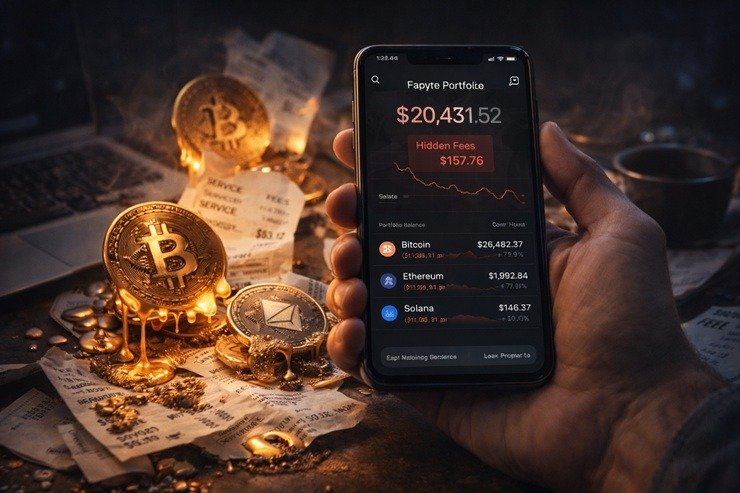
Everyone watches the charts. Bitcoin up 5%—portfolio looking good. Ethereum down 3%—time to buy the dip. We obsess over price movements while quietly bleeding money to fees that add up to more than most market swings.
I tracked every fee on my crypto portfolio for six months. Trading fees, withdrawal fees, network fees, spread costs, conversion charges. The total came to 4.2% of my portfolio value. In six months. That’s an 8%+ annual drag on returns before accounting for any market movement.
Most people have no idea what they’re actually paying. The fees hide in different places, get labeled different things, and rarely show up as a single number you can point to. Let’s fix that.
Trading Fees Aren’t the Problem
Everyone knows about trading fees. Buy Bitcoin, pay 0.5%. Sell Ethereum, pay another 0.5%. These show up clearly on your transaction history. They’re annoying but at least visible.
Trading fees aren’t where the money disappears though. Most exchanges charge 0.1% to 0.5% per trade. If you’re not actively day trading, you might execute a handful of trades per month. That’s maybe $20-50 in fees on a $10,000 portfolio.
The real costs hide elsewhere.
Withdrawal Fees Add Up Fast
Here’s what actually hurts: withdrawal fees.
Exchanges charge a flat fee to send crypto to your wallet. These fees vary wildly and bear no relationship to the amount you’re withdrawing. Sending $100 in Ethereum costs the same as sending $10,000—usually around $15-25 per withdrawal.
This creates perverse incentives. You want to move crypto to your own wallet for security. But every withdrawal costs money. So you consolidate—wait until you have a meaningful amount, then withdraw it all at once to minimize fee impact.
Except markets don’t wait for your fee optimization strategy. Prices move. You wanted to withdraw last week but you were waiting to save $15 in fees. The market dropped 8% in the meantime. You saved $15 and lost $800.
Over six months, I paid $347 in withdrawal fees. That’s more than I paid in trading fees. And that’s with me being conscious about minimizing withdrawals. Most people pay more.
The Spread Nobody Talks About
Buy Bitcoin on an exchange and you’ll see two prices: the bid and the ask. The bid is what someone will pay to buy Bitcoin from you. The ask is what you have to pay to buy Bitcoin from someone else. The gap between them is the spread.
On major exchanges during normal conditions, the spread runs 0.1% to 0.3%. Doesn’t sound like much. But it’s a hidden tax on every transaction that compounds with other fees.
Here’s how it plays out: you buy Bitcoin and immediately pay the spread—maybe 0.2%. Later you sell and pay the spread again—another 0.2%. Plus trading fees both ways—another 0.5% each direction. Your round trip cost? About 1.6% of the transaction value.
That means Bitcoin needs to appreciate more than 1.6% just for you to break even on a buy-and-sell cycle. You’re starting every trade in a hole.
The spread widens during volatility. Trying to buy Bitcoin during a sharp price move? That 0.2% spread might balloon to 1% or higher. The chaos creates opportunity for traders who provide liquidity, and cost for traders who need immediacy.
Network Fees Are Lottery Tickets
Ethereum network fees swing from $2 to $50 depending on when you transact. Sometimes you’ll pay $3 to send a transaction. Other times the same transaction costs $40. The difference? Network congestion.
This randomness makes planning impossible. You might budget $5 for gas fees, check the network, and find gas costs $35. Now what? Wait and hope it drops? Pay the inflated fee? Either choice has costs.
I started tracking when network fees were lowest. Weekends and late night UTC generally see lower fees. But “lower” is relative—instead of $30, you might pay $15. Still expensive for small transactions.
Some people try to time network fees perfectly, waiting for the optimal moment. This works until you’re waiting for fees to drop while the asset you wanted to buy pumps 15%. You saved $20 in gas and missed a $1,500 gain.
Conversion Costs Nobody Sees
Want to convert Bitcoin to Ethereum? The obvious method: sell Bitcoin for dollars, buy Ethereum with dollars. Two trades, two sets of fees, two spreads. Your conversion cost might hit 1-2% of the amount.
Some exchanges offer direct crypto-to-crypto trading pairs. Sounds efficient. But check the spread on BTC/ETH pairs versus BTC/USD and ETH/USD pairs. Often the direct pair has a wider spread that eats up any fee savings.
Then there’s the slippage question. Small conversions usually execute at the quoted price. Larger conversions move the market—your order eats through available liquidity and you get progressively worse prices as the order fills. The bigger the conversion, the worse the effective price.
Direct swap services like Changeum.io emerged to address this problem. Rather than trading through order books with spreads and slippage, wallet-to-wallet swaps calculate a fixed rate and execute the conversion directly. For many conversions, this ends up cheaper than exchange trading once you account for all the hidden costs.
The Rebalancing Trap
Portfolio rebalancing sounds smart. Maintain target allocations—60% Bitcoin, 30% Ethereum, 10% other. When allocations drift, trade back to targets.
In traditional markets, rebalancing costs are low. Your broker might charge $5 per trade. Rebalancing a three-asset portfolio costs $15 twice a year—negligible.
In crypto, rebalancing gets expensive fast. Each rebalance requires selling overweight positions and buying underweight ones. Figure 1% in total fees per rebalance across all the costs we’ve discussed. Rebalance monthly and you’re burning 12% annually in fees. Your portfolio needs to outperform a static allocation by 12% just to break even.
Some people use decentralized exchanges for rebalancing to avoid withdrawal fees. Makes sense—convert directly between assets without moving funds to and from exchanges. Using wallet-to-wallet conversion services eliminates multiple fee layers. Instead of withdraw, deposit, trade, withdraw again, you execute one atomic swap.
Compound Fees Kill Compounding Returns
Fees compound negatively just like returns compound positively.
Start with $10,000. Grow it 20% per year for five years with zero fees: you end with $24,883. Now apply 2% annual fees. You end with $21,911. The fees cost you $2,972—nearly 12% of your final portfolio.
That 2% fee drag might sound conservative, but add up all the fee categories: trading fees, withdrawal fees, spread costs, network fees, conversion fees. For active portfolios, 2% is low. Some people pay 5% or more annually without realizing it.
At 5% annual fees, that same $10,000 grows to only $18,766 over five years. You still made money, but fees consumed $6,117—almost a quarter of what your returns should have been.
Fee Optimization That Actually Works
So what do you do about this?
First, track your fees. All of them. Spend a month noting every fee you pay and categorizing it. You can’t optimize what you don’t measure. Most people discover they’re paying way more than they thought.
Second, consolidate exchange activity. Every additional platform you use multiplies fee opportunities. Spreading a portfolio across three exchanges means three sets of withdrawal fees, three sets of trading fees, three sets of deposit requirements. Pick one primary platform and minimize activity elsewhere.
Third, batch transactions strategically. Withdrawal fees are flat, so batching larger withdrawals reduces fee impact. Instead of withdrawing $500 five times ($75 in fees), withdraw $2,500 once ($15 in fees). The fee savings are real even if the timing is imperfect.
Fourth, use limit orders instead of market orders when possible. Market orders pay the spread and sometimes extra fees. Limit orders often qualify for lower fees and let you set your price. The trade-off is execution uncertainty, but for non-urgent trades the savings add up.
Fifth, consider direct swap services for conversions. Platforms like Changeum.io that handle wallet-to-wallet exchanges eliminate multiple fee layers—no deposit fee, no withdrawal fee, no order book spread. Just a transparent conversion rate. For portfolio rebalancing or asset rotation, this often beats the traditional exchange route.
The Bottom Line
Fee obsession can go too far, but most people aren’t anywhere near that problem. They’re on the opposite end—completely unaware of what they’re paying.
The goal isn’t eliminating fees. That’s impossible. The goal is making fees visible and intentional. Every fee should be a conscious trade-off where you know what you’re paying for and whether it’s worth the cost.
Most crypto traders operate fee-blind. They know fees exist but don’t track them, don’t minimize them, don’t think about cumulative impact. The market provides enough drama that fee optimization feels boring in comparison.
But boring optimization compounds. Cutting fee drag from 4% to 2% annually might not feel exciting. Over a decade, it’s the difference between turning $10,000 into $21,911 versus $24,883. That’s $3,000 you kept instead of donating to exchanges and networks.
Markets might give you 50% gains or 30% losses in a year. Fees will definitely cost you 2-5% if you’re not watching. You can’t control market returns. You can control fee drag.
Start tracking. You’ll probably be horrified. Then you’ll get annoyed. Then you’ll optimize. And you’ll keep a few percentage points that compound into real money over time.
It’s not sexy. It’s just profitable.













The Hidden Fees Eating Your Crypto Portfolio (And How to Avoid Them)

Premium Car Services | Professional Black Car & Executive Transport

The Strength It Takes to Prepare for Life’s Hardest Moments

Red Rocks, CO: Season Opens, Concerts Begin, and the Geology Is Still Ancient

Brand: What to Look for in a Senior Living Guide

Smart Financial Habits Every Globetrotting Entrepreneur Should Master

How Overcoming Physical Setbacks Fuels Unbreakable Mental Resilience

Improve Delivery Accuracy with Smarter Driver Navigation

Comprehensive Guide to Medication-Assisted Treatment (MAT) at SOAP MAT

How to Negotiate Better Car Loan Terms with Your Lender

100 Motivational Quotes to Inspire You in 2026

100 Motivational Quotes to Start Your Day with Positivity

22 Best Self-Help Books to Read in 2026

How to Create a Vision Board That Actually Works (2026)

Changing Your Spending Habits

How to Achieve Personal Growth in 2026

New Year Wishes and Quotes to Inspire and Celebrate (2026)

Top 50 Motivational Quotes for Success and Hard Work

Do I Have to Pay a Debt That’s Very Old?

5 Excellent Reasons for a Healthcare Provider to Utilise the Services of a Nursing Agency
-

 Motivation5 years ago
4 Fun New Hobbies To Try This Year
-

 Quotes3 years ago
53 Motivational Gym Quotes to Fuel Your Workout
-

 Travel1 year ago
Why You Should Travel More: The Many Benefits of Seeing the World
-

 Quotes10 years ago
50 Most Powerful Quotes Ever Spoken
-
 Quotes3 months ago
100 Motivational Quotes to Inspire You in 2026
-

 Quotes2 years ago
43 Inspirational Quotes About Thoughts
-

 Quotes3 years ago
105 Motivational Quotes by Famous People
-
 Quotes9 months ago
100 Motivational Quotes to Start Your Day with Positivity