
Education
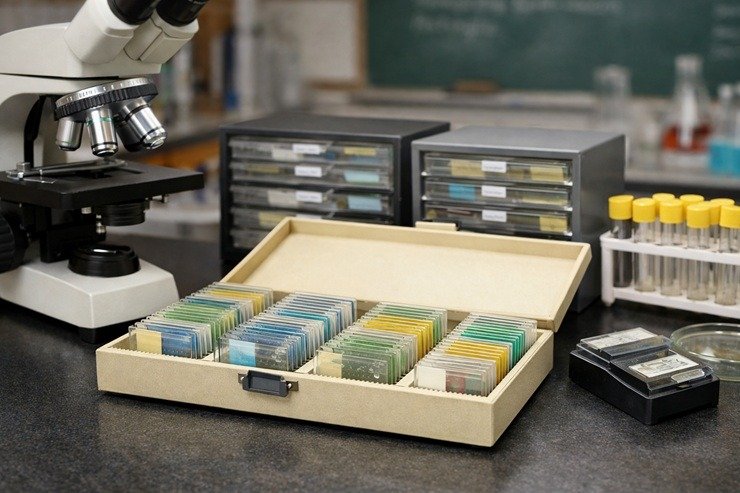
Educational Settings: Microscope Slide Storage for Schools and Universities

The bell rings in five minutes.
A lab assistant is halfway inside a cabinet, whispering, “Where did the mitosis slides go?” A student is already spinning on a stool. Someone just asked if they can “borrow” a slide from another group.
And the drawer? It sticks.
Welcome to the reality of microscope slide storage in schools and universities.
It’s not quiet. It’s not controlled. It’s not gentle.
And that changes everything.
High-Traffic Labs = High-Stakes Storage
Research labs are calm. Educational labs are… not.
Slides move constantly. Students retrieve them. Compare them. Swap them. Occasionally return them to the wrong slot. Occasionally return them upside down. (It happens.)
That kind of movement increases risk. Chips. Cracks. Worn labels. Mixed specimen sets. The slow erosion of order.
The National Science Teaching Association stresses the importance of structured lab management to support effective instruction (NSTA.org). Storage systems are part of that structure. If slides are disorganized, teaching slows. If teaching slows, engagement drops.
And in a 50-minute class period, every minute counts.
Microscope slide storage in education isn’t passive. It has to withstand motion.
Organization Isn’t Aesthetic. It’s Academic.
Here’s a question: how long should it take to find a cross-section of a dicot stem?
Thirty seconds? Two minutes? Five?
If the answer is “we’ll see,” that’s a storage problem.
Slides in schools support specific curriculum objectives—botany units, histology comparisons, AP Biology labs, undergraduate research modules. Faculty need quick retrieval. Lab assistants need predictable organization. Students need clarity.
Structured microscope slide storage systems solve this by offering:
- Categorized drawers (botany, zoology, anatomy, etc.)
- Divided compartments to prevent slide contact
- Clear external labeling
- Sufficient capacity to avoid overcrowding
When slides are stacked horizontally in a cardboard box “for now,” that “now” tends to last years. And cardboard isn’t archival. It’s temporary optimism.
Order supports instruction. Period.
Durability: Because Students Are Students
Let’s be honest.
Cabinets in educational labs get bumped. Leaned on. Opened quickly. Closed harder than necessary. Temperature and humidity may fluctuate—especially in older school buildings that weren’t designed with laboratory precision in mind.
Office furniture doesn’t stand up to that.
Purpose-built microscope slide storage cabinets are engineered for laboratory environments. High-quality systems—like those manufactured by Eberbach Cabinets—feature durable materials, reinforced structures, and smooth-glide drawer mechanisms that maintain alignment over time.
Because let’s be clear: a filing cabinet is not the same thing as a specimen cabinet.
And slides deserve better than “close enough.”
Budget Reality: Replacement Isn’t Cheap
Prepared slide collections are expensive. Especially comprehensive ones.
K–12 schools often invest thousands into complete biology sets aligned with curriculum standards. Universities may maintain specialty collections spanning decades. Some slides are difficult to replace. Some are discontinued entirely.
Improper storage shortens lifespan. Slides rub against each other. Labels fade from exposure. Dust settles inside drawers that don’t close tightly.
The National Institutes of Health emphasizes stable environmental conditions for preserving laboratory materials (NIH.gov). While NIH guidance often applies to research institutions, the preservation principle is universal: protect materials properly and they last longer.
In education, longevity equals fiscal responsibility.
Replacing slides annually because drawers are overcrowded? That’s avoidable.
Safety Isn’t Optional
Now let’s talk about glass.
Broken slides in a classroom aren’t just inconvenient—they’re hazardous. Sharp fragments in a shared learning space create injury risk. Overcrowded drawers increase the likelihood of cracking when opened. Poorly supported drawers can tilt, shifting internal contents.
Modern storage systems often include:
- Full-extension ball-bearing slides
- Anti-tip safety mechanisms
- Balanced drawer weight distribution
- Internal dividers that reduce slide movement
If a drawer jerks forward when opened, that’s not “normal wear.” That’s instability.
Storage should feel solid. Predictable. Controlled.
Anything else invites trouble.
Professionalism Matters (Even in Schools)
Picture a prospective university student touring a biology department.
The microscopes are updated. The lab benches are clean. Then they see mismatched cabinets with peeling veneer and handwritten tape labels.
It doesn’t ruin the department’s credibility. But it whispers.
Infrastructure reflects priorities. Uniform, well-maintained microscope slide storage signals that the institution values preservation and organization. That matters—to students, faculty, and accreditation reviewers.
Small details reinforce big standards.
Growth Happens. Storage Should Too.
Curriculums expand. New electives launch. Advanced placement courses grow. Universities add microbiology tracks, pathology modules, or biomedical programs.
Slide collections expand accordingly.
Without scalable storage, institutions resort to patchwork solutions—extra boxes, borrowed drawers, temporary stacking systems. Temporary systems tend to become permanent. And permanent improvisation rarely ages well.
Planning for expansion avoids future chaos.
A Quick Gut Check
Ask yourself:
Are slides overcrowded?
Do drawers glide smoothly?
Are specimens clearly categorized?
Are cabinets structurally stable?
Does retrieval disrupt lesson flow?
If you hesitated—even slightly—it might be time to reassess.
Microscope slides are small. But they carry big weight. For some students, they’re the first real look into cellular life. For others, they’re the foundation of a medical or research career.
Storage doesn’t get applause. It doesn’t show up in course catalogs.
But when it works, everything else works better.
And when it fails?
You hear it first in the drawer.














5 Things Business Owners Need to Know About Cash Flow

The Future of Home Living: Things That Are Changing Everyday Comfort

What Delays Government Construction Projects Most Often?

Oklahoma City Real Estate Market: Trends and Strategies for 2026

What Should Aging Homeowners Know About HVAC Cleaning?

Animated Banners and the Performance Math Nobody Wants to Do

Are Businesses Focusing on the Right Problems When Implementing AI Automation?

How Mobile Connectivity Impacts Netflix and OTT Streaming Experience

Tips for Managing Personal Finances as an Aspiring Entrepreneur

Red Rocks Amphitheatre 2026: Concert Season Preview and What to Know Before You Go

100 Motivational Quotes to Inspire You in 2026

How to Create a Vision Board That Actually Works (2026)

22 Best Self-Help Books to Read in 2026

Changing Your Spending Habits

How to Achieve Personal Growth in 2026

New Year Wishes and Quotes to Inspire and Celebrate (2026)

Do I Have to Pay a Debt That’s Very Old?

Navigating Career Growth in Healthcare: Tips for Recent Graduates and Career Changers

Indian Couple’s Guide to a Romantic Bali Getaway

Loeb Smith reviews: Why Crypto Licensing Demands Patience, Structure, and Skepticism
-

 Motivation6 years ago
4 Fun New Hobbies To Try This Year
-

 Quotes3 years ago
53 Motivational Gym Quotes to Fuel Your Workout
-

 Travel2 years ago
Why You Should Travel More: The Many Benefits of Seeing the World
-

 Quotes11 years ago
50 Most Powerful Quotes Ever Spoken
-
 Quotes7 months ago
100 Motivational Quotes to Inspire You in 2026
-

 Quotes2 years ago
43 Inspirational Quotes About Thoughts
-

 Quotes4 years ago
Motivational Quotes by Famous People
-

 Quotes1 year ago
100 Motivational Quotes to Start Your Day with Positivity