
Health
How to Rebuild Your Daily Routine After a Serious Injury


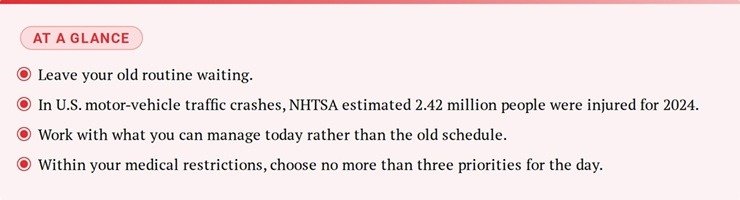
After a personal injury, the alarm might ring while you’re still awake with pain. Unopened paperwork waits while you lack the energy to make breakfast; your appointment competes with messages you haven’t answered. Let your old routine wait while you recover. The National Highway Traffic Safety Administration estimated that 2.42 million people were injured in U.S. motor-vehicle traffic crashes in 2024, compared with 2.44 million in 2023. If a crash or another serious injury has you recovering, work with what you can manage today rather than the old schedule still sitting in your planner.
Rebuild a daily routine after a personal injury
Start with current capacity
Within your medical restrictions, choose no more than three priorities for the day. Leave some space unscheduled for symptoms or fatigue. Those priorities can be one care task, one administrative task, and one household or work task.
Give each task a simpler version for harder days. On an appointment day, showering and eating may be your entire household plan. A difficult day isn’t a sign you’ve failed. If standing through a shower became harder, for example, write that down.
Use anchors instead of a rigid hourly schedule
With fixed care commitments in place, fit optional tasks into the space around them. Use medication instructions or an appointment as an anchor. To make room, shift your other activities around without moving prescribed doses.
| Part of day | Fixed anchor | Flexible task | Stop cue |
|---|---|---|---|
| Morning | Prescribed care and breakfast | One hygiene or household task | Pain or dizziness increases |
| Midday | Appointment or planned rest | One call or form | Concentration drops |
| Afternoon | Meal and recovery break | Approved movement or light work | Symptoms reach the limit set by the clinician |
| Evening | Medication instructions and wind-down | Prepare one item for tomorrow | Usual bedtime arrives |
Review the routine once a week
Take five minutes once a week to notice unfinished tasks. After marking what you did before symptom flare-ups, decide which tasks someone else could take on. Ask your treating professional before changing any prescribed treatment.
Put appointments, rest, and medication instructions in one calendar
Schedule recovery before optional obligations
Use one calendar for appointments and rest. Enter visits and prescribed care first, allowing time for travel and recovery buffers. Fit optional obligations into the space left over.
Rest gets its own block. After an exhausting appointment, your note might read “Lunch and quiet rest until 2:00 p.m.” Check your transportation arrangements before adding an errand to the trip. If someone drives you, confirm pickup time when you book the visit. Only use alarms that help and fit your care instructions.
Keep the daily priority list short
Write tomorrow’s priorities the night before or after breakfast. Choose tasks with a clear endpoint: “call the clinic about the bill,” rather than “fix medical finances.” If concentration fades during the call, record the name of the person you spoke with before pausing.
Keep questions that can wait for your next appointment in a separate note. That note could hold an unfamiliar term from your discharge instructions. Do not add new or concerning symptoms to that note. Instead of adding those symptoms to a waiting list, follow your care team’s instructions for making contact.
Stop at three priorities.
Organize medical records without letting paperwork take over
Create one central folder
Choose one physical binder or a secure digital folder for your injury paperwork. Separate work records from your medical documents. Keep accident or insurance correspondence together, and store receipts in their own section.
Name files consistently, beginning with the date and following it with the source and document type: “2024-06-18 Clinic Discharge Instructions.” Write the date you received paper records on an envelope or divider. Leave the original document unchanged.
Contain administrative work
Rather than keeping documents in view all day, set aside one or two 20-minute paperwork windows each week. Record the contact date and the person or organization you contacted in an action log. Record the next action and its deadline. You can resume at “await corrected bill” without rereading every statement.
Before your next paperwork window, deal with any document whose deadline is approaching. Ask someone you trust to help sort it if fatigue makes reading too difficult.
On public roads that year, Kentucky recorded 29,235 people injured in collisions, according to its 2024 Traffic Collision Facts report. Store the accident report number with that correspondence if you were injured in a collision.
Keep your questions beside the accident and insurance correspondence if you’re planning to speak with a Louisville lawyer about personal injury claims. Also keep any workplace or medical documents you want to discuss there.
Know when recovery needs more hands
Match the request to the person who can address it
When household demands repeatedly push care or rest aside, ask family or friends to help. Make the request specific: a ride to Thursday’s appointment or help with dinner. If medical restrictions affect your attendance or assigned duties, ask your employer who should receive the written restrictions when you contact them.
When symptoms change or the instructions aren’t clear to you, call your healthcare provider. A call is also warranted for medication problems or emotional distress that interferes with eating or basic self-care. Ask someone to sit with you during a difficult call.
Respond promptly to a workplace injury
When you need emergency care, get it. Report a workplace injury through your employer’s established process as promptly as possible. Keep copies of the related documents, and write down when and how it happened.
The Occupational Safety and Health Administration provides general guidance about workers’ rights to report work-related injuries. Your location and employment arrangement determine the reporting and claim requirements. Don’t depend on a coworker’s understanding of the reporting deadline.
You might turn to a lawyer for advice about legal rights or deadlines. It’s also worth seeking advice about a specific letter or request when responsibility is disputed or an insurer’s communications aren’t clear.
Short answers to difficult recovery questions
What can delayed shock look like after a car accident?
When blood flow isn’t adequate, that’s medical shock, a life-threatening condition. Warning signs listed by MedlinePlus include rapid breathing and pale or clammy skin. A weak pulse can also occur, along with confusion, fainting, or severe weakness. Call emergency services for suspected shock, including when symptoms don’t appear until later. A routine appointment isn’t soon enough.
What does a trauma injury mean?
When an external force injures the body, as in a collision or fall, that’s physical trauma. Trauma can also come from burns or penetrating objects. The affected area and the force involved determine severity, with the resulting damage also playing a part. After the same event, psychological trauma can occur too, though it’s different from physical trauma.
Can an injury contribute to depression?
Yes, depression can develop with pain and disrupted sleep. Isolation can contribute too, along with reduced mobility and uncertainty. The National Institute of Mental Health advises getting professional help for persistent symptoms or difficulty functioning. Call or text the U.S. Suicide and Crisis Lifeline at 988 for prompt support with thoughts of self-harm. Call emergency services when there’s immediate danger.
Which injury is the hardest to heal?
There’s no one injury that’s hardest to heal. Severity and blood supply affect healing, along with infection risk. Rehabilitation access also affects recovery, alongside your health and age. Some brain or spinal cord damage can cause lasting impairment; complex fractures and damaged tendons can take a prolonged time to heal.
What are five signs you may need a mental health day?
These difficulties can signal a need to pause:
- You cannot concentrate on ordinary tasks.
- Irritability is affecting routine conversations.
- Your sleep has been disrupted by consistent interruptions.
- Normal obligations fill you with persistent dread.
- Because you’re emotionally exhausted, basic self-care feels difficult.
These aren’t diagnostic criteria. A rest day may provide breathing room, but it can’t replace professional care for persistent symptoms or safety concerns.
What belongs in a basic recovery routine?
Make room for prescribed care and meals, and protect your rest. Include one short administrative period and no more than three priorities. Add contact details for symptom changes or practical support, such as your clinic’s after-hours number.
A routine you can repeat tomorrow
To regain control, you don’t have to recreate your old schedule. A repeatable routine keeps treatment protected while putting limits on paperwork and making help easier to request. By tomorrow, your capacity may change. You can change the plan without making it a test of willpower. Write down up to three priorities after choosing tomorrow’s care anchor. Keep one block of time open.













How to Rebuild Your Daily Routine After a Serious Injury

How Virtual Crypto Cards Simplify USDT Spending

How To Compare Houston, Texas Neighborhoods Before Buying a Home

Interactive Museums in Miami, Florida: Five Hands-On Attractions Worth Visiting

Why Short Financial Gaps Need Different Solutions

How Admissions Teams Use Viddo AI For Campus Walkthroughs

The Trouble with Being Right

Remembering With Love: Meaningful Ways to Honor Someone After Loss

5 Things to Know Before Your First Art Auction

Running Research Labs: Essential Resources to Enhance Operations

100 Motivational Quotes to Inspire You in 2026

How to Create a Vision Board That Actually Works (2026)

22 Best Self-Help Books to Read in 2026

How to Achieve Personal Growth in 2026

New Year Wishes and Quotes to Inspire and Celebrate (2026)

Loeb Smith reviews: Why Crypto Licensing Demands Patience, Structure, and Skepticism

How to Choose the Best Manali Tour Package for a Family-Friendly Vacation?

Your Guide to Building the Life You Want as a Medical Professional

Romantic Cabins In Tennessee: A Guide to Location, Privacy, And Scenic Views

AI SEO Tools Every Website Owner Should Know
-

 Motivation6 years ago
4 Fun New Hobbies To Try This Year
-

 Quotes4 years ago
53 Motivational Gym Quotes to Fuel Gym Workout
-

 Quotes11 years ago
50 Most Powerful Quotes Ever Spoken
-

 Travel2 years ago
Why You Should Travel More: The Many Benefits of Seeing the World
-
 Quotes11 months ago
100 Motivational Quotes to Inspire You in 2026
-

 Quotes3 years ago
43 Inspirational Quotes About Thoughts
-

 Quotes4 years ago
Motivational Quotes by Famous People
-

 Quotes1 year ago
100 Motivational Quotes to Start Your Day with Positivity