
Business
Animated Banners and the Performance Math Nobody Wants to Do

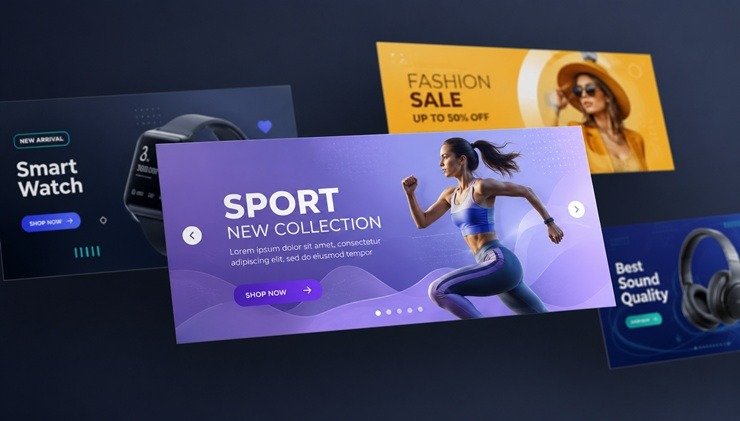
Most performance teams I’ve worked with have, at some point, run the experiment: static control versus animated test, same audience, same placement, equal budget. Most of the time, the result is the same. Animated lifts CTR a bit. Not dramatically. Not enough to make a slide deck about. But consistently, across enough placements, enough categories, enough audiences, that you stop running the experiment after a few cycles and just start producing animation as default.
That’s the case for animated banners in performance marketing in one paragraph. They outperform static. Modestly. Often enough that the marginal cost of producing animation is worth eating.
The case against is also pretty simple: animation costs more per asset, fatigues at a similar rate to static (sometimes faster), and the production cycle adds enough friction that teams quietly stop using it once volume requirements ramp up.
Both things are true at once. Which one wins comes down to whether the team has solved the production side.
What the numbers actually look like
The honest version of the data isn’t “animation lifts CTR by 47%” (the number every banner tool’s landing page seems to quote). It’s closer to “animation lifts CTR by between 5% and 30% relative, depending on placement and creative quality.” On programmatic display, where baseline CTRs run between 0.05% and 0.5%, that’s still meaningful absolute movement, but you have to be honest about it. The lift isn’t magical. It’s incremental. It compounds because it shows up across most placements, not because any single placement gets transformed.
The compounding is where the actual win lives. A 15% relative lift in CTR, applied across an entire display program and sustained over a campaign cycle, represents a meaningful budget efficiency gain. Not in any single banner. In the portfolio.
The other compounding effect: animated banners hold up better in remarketing audiences. The viewer has already met the brand. The job isn’t an introduction — it’s a memory refresh. Subtle motion does this work better than a static refresh of the same elements. Not by a lot. But consistently.
Where teams give it up
The recurring failure pattern with animated banners is almost always production-side rather than creative.
The cycle goes like this. Team launches a campaign with two or three animated creatives. They perform well. The team starts using the data to optimize. Optimizations require new variants — different headlines, featured products, CTAs, and color palettes for audience cuts. New variants require designer time. Designer time is constrained. By week six, the team is shipping static refreshes because they’re faster to produce. By week eight, the campaign is mostly static. By week twelve, ad fatigue has set in, and the team concludes the campaign “ran its course.”
The animated creative didn’t fail. The pipeline did. The performance gain was real; the team just couldn’t hold the rotation.
This is the actual reason a decent animated banner creator is worth the investment for performance teams. Not because banner design is hard. Banner design isn’t that hard. But because the campaigns that get the most from animation are also the ones with the highest production demands, the format and workflow have to be addressed as a single problem. Solving one without the other is how teams end up saying animation “doesn’t work for us” when what actually happened is they couldn’t feed it.
Rules that survive contact with actual campaigns
If you’re going to invest in animated banners, a small set of principles tends to determine whether the investment compounds or evaporates.
One offer per banner. Don’t combine the product launch with the discount with the brand campaign. The temptation is constant. The math is brutal: a banner trying to communicate three things communicates none.
The first frame has to work alone. Most viewers see only the first frame. If frame one doesn’t carry the offer, the rest of the loop is decoration. This single rule explains more variance in banner performance than anything else I’ve tested.
Motion supports the message. If the most memorable thing about your banner is the animation, the banner isn’t doing its job. Animation is a delivery mechanism, not the product.
Brand consistency across variants. A banner that drifts from the brand erodes recognition regardless of how well it animates. Recognition is a slow asset; don’t chip away at it for a CTR point.
These aren’t novel. Most performance teams arrive at this list after burning a few thousand dollars on test budgets that should have been spent on production capacity instead. Compressing that lesson up front doesn’t make the work easy, but it makes the spending compound in the right direction.








Why Saying “Yes” is More than a Milestone: It’s a Mindset Shift

Success at Work, Meaning at Home: Redefining What a Successful Life Looks Like

Hit by a Lyft Driver? Steps to Protect Your Health and Your Claim

How Financial Planning Can Help You Build a More Secure Future

Underground Water Leak Detection Services: Essential Considerations for Homeowners

Why People Wear Fragrance Even When They’re Staying Home

Hair Transplant Technology in Istanbul

Creating Your Own Rituals for Rest, Reflection, and Personal Time

How Hiring A Professional Plumber Saves You Money On Water Bills

Plumbing Emergencies: A Homeowner’s Guide for Finding a Plumber Near Me

100 Motivational Quotes to Inspire You in 2026

How to Create a Vision Board That Actually Works (2026)

22 Best Self-Help Books to Read in 2026

How to Achieve Personal Growth in 2026

New Year Wishes and Quotes to Inspire and Celebrate (2026)

Loeb Smith reviews: Why Crypto Licensing Demands Patience, Structure, and Skepticism

Top Fitness Coach Certification Programs for Aspiring Trainers

From Denver to Vail: Secrets, Snow, and Soul of the Rockies

How to Choose the Best Manali Tour Package for a Family-Friendly Vacation?

Your Guide to Building the Life You Want as a Medical Professional
-

 Motivation6 years ago
4 Fun New Hobbies To Try This Year
-

 Quotes4 years ago
53 Motivational Gym Quotes to Fuel Gym Workout
-

 Quotes11 years ago
50 Most Powerful Quotes Ever Spoken
-

 Travel2 years ago
Why You Should Travel More: The Many Benefits of Seeing the World
-
 Quotes10 months ago
100 Motivational Quotes to Inspire You in 2026
-

 Quotes3 years ago
43 Inspirational Quotes About Thoughts
-

 Quotes4 years ago
Motivational Quotes by Famous People
-

 Quotes1 year ago
100 Motivational Quotes to Start Your Day with Positivity