
Business
Beyond Website Traffic: 7 Digital Marketing Signals That Reveal Who Is Ready to Buy

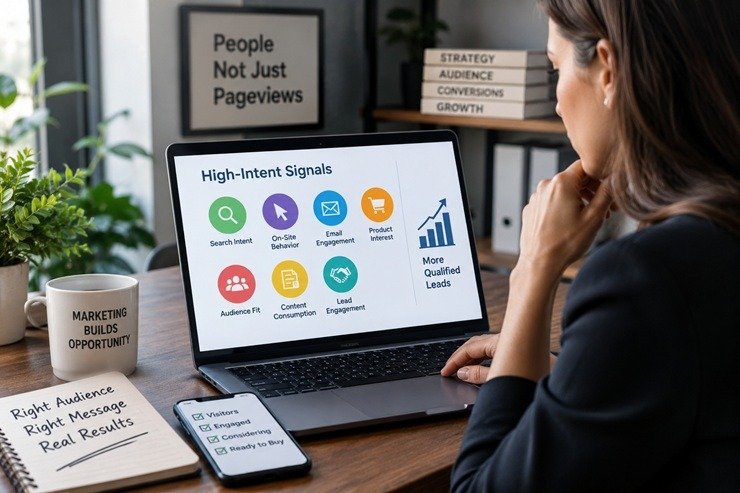
Website Traffic is not purchase intent as a company could have 10,000 visitors per month, thousands of social interactions and hundreds of content downloads. The issue is that web traffic only really tracks attention. Research by Gartner regarding B2B buying journey says that an overwhelming section of buying committee’s time involved in evaluation is spent in buying committee’s independent online search before talking to sales person at any given point. A visitor glancing at the top-of-funnel blog post is not equal to a single account which keeps visiting pricing matrices, comparing software capabilities or studying data sheets over and over again.
These types of interactions offer more information on how a specific visitor stands within the buying process. B2B Marketers aren’t seeking more visitors; they need to know which visitors may have a business purpose to be looking at your website. The competitive edge is learning to recognize those specific indicators separating curiosity and purchase intent.
7 Digital Marketing Signals That Indicate Purchase Intent
Signal 1: Repeated Visits to High-Intent Pages
You can’t weigh a website by visiting equally. While your prospect may just be browsing a general “what is” blog post, one that visits “product pages,” “pricing information,” “case studies,” “comparisons,” “implementation,” and “contact pages,” is showing a different set of traits. Not only does frequency matter; so does the page.
Five views of educational pages shows that a potential prospect is actively learning, while even two views of the product page and the pricing page may mean that a visitor is closer to purchase consideration than a prospect visiting five times more of other pages. Avoid giving all web pages an equal rating.
Signal 2: A Shift From Educational Content to Decision Content
One of the best signals possible is a shift in consumption. When a prospect moves beyond generalized early stage questions “What is a CRM,” “How does marketing automation work,” to solution focused searches like “best CRM for enterprise teams,” “CRM pricing,” “Salesforce vs. HubSpot,” or “CRM implementation checklist” these questions offer significant insight into commercial buy intent, as it is now a clear move from an examination to decision-oriented investigation.
Your prospect has moved from the awareness phase to the consideration phase. Rather than simply analyzing an amount of content consumption, it’s time to consider the progression the engagement is taking: learning, investigating, comparing, validating. This can tell you a great deal more about commercial intent than quantity.
Signal 3: High-Value Conversion Actions
While certainly another signal they’re not necessarily of equal weight. Requests for product demos, information on pricing, a free trial, consultative conversation or technical spec sheet generally show more commercial intent than the downloadable intro ebook. Other actions like webinar sign ups, purchase guides, requests for implementation information are also good.
This is about giving different intent weight to actions. Thus a download for an informative paper, in certain cases, only shows a developing level of interest, while the inquiry about pricing is a strong evaluative indicator. By understanding this marketers can rank prospects in terms of behavior instead of simply counting conversions.
Signal 4: Returning Engagement Across Multiple Channels
The one true channel to which you convert does not give you every indicator you need. It may start on LinkedIn, move to a webpage, prompt an email subscription, trigger an alert on a product feature, come back on a search and perhaps culminate in a webinar. In the context of a single event each engagement does not carry that much weight. A pattern, however, indicates the potential strength of their purchase signal.
By combining touchpoints from LinkedIn, web analytics, and a marketing automation system such as HubSpot or Marketo, revenue teams are able to construct full account journeys rather than discrete events with little context. The better your prospect displays multi-channel engagement, the more powerful and indicative of their purchasing intent the combined signal is to use for ranking your prospects.
Signal 5: Engagement With Comparison, Review, and Competitor Content
When a prospect is researching the general problem, they may not necessarily be ready for vendor selection. But as the same prospect begins reviewing comparison articles, competitor pages, reviews, alternatives, migration guides, and best tools or content, their search becomes about “what will solve my problem?” into “what kind of solution will solve my problem?” Which is moving close to the purchase evaluation phase.
That’s why, for B2B marketers, engagement in comparison and evaluative content can be quite powerful. It potentially signifies that a prospect has discovered their problem, looked at potential ways to solve it, and are now evaluating options among the vendors.
Signal 6: Business Events That Create a Reason to Buy
Some of the best buying signals lie outside of your website. The hiring of a new executive, market expansion, venture funding, a growing head count, technology upgrade, merger, or re-org might suddenly necessitate that a business gain new requirements. For instance, a company pushing into several new markets might need new technology, services, infrastructure or marketing support.
These contextual buying signals, once paired with digital activity, can be powerful to identify opportunities. Customer intelligence focuses on defining buying signals apart from behavioral intent, emphasizing those external business events, such as executive hiring, funding events, technology upgrades, geographical expansion, mergers, and an increasing employee headcount.
The blend of what a company is actually doing, versus what its employees are researching can deliver far more contextual information.
Signal 7: Multiple Decision-Makers From the Same Company Engage
It is rare for purchases to be made in B2B with the input of just one person. What happens if an individual from the account looks at your site, another downloads the guide, a manager attends a webinar and an executive later examines your pricing page?
Tools like ZoomInfo or Clearbit and IP de-anonymization make it possible for teams to link together website visits that should, in principle, be traced back to a single parent organization. It is highly correlated with a buying committee that is ramping up for an evaluation if: the analyst visits a white paper, the engineer spends time on API docs, and the CEO looks at pricing-all within a 14 day span. These account-level events, in particular, can be helpful for prioritization purposes.
How to Turn Digital Signals Into a More Reliable Buying-Intent Score
However, signals will not deliver value unless your team has actions in place to capitalize on them. Begin by knowing what happened. The prospect landed on pricing, downloaded an e-book, viewed a competitor page, or returned to a product page.
Assign a level of intent from a high level “learning and exploring,” to increasing “exploring intent” to high level intent indicated by strong evaluation or repeated coordinating signals. Combine behavioral signals with context is that the company is expanding + key decision-makers hit pricing page + many employees on product content = high potential account.
The response should align with the signal; educational content will be appropriate in many cases of earlier intent, but relevant case studies, a comparison page, consultation, or active sales outreach makes sense to meet evaluation-oriented signaling. Turn raw marketing behaviors into action based on intelligence. The inclusion of rich firmographic, technographic, contact and intent information will allow this intelligence to serve throughout the revenue cycle.
Conclusion: Stop Optimizing Only for More Visitors
More website traffic may be helpful, but there’s not really an answer based on that about who is most likely to buy. The real question to ask is: What are your visitors doing, and what behavior patterns are changing?
Return visits, high-intent content, true conversion actions, engaged cross-channel usage, or comparison research combined with business changes and multiple engaged decision makers give you a far better view of the interest to purchase. Tomorrow’s digital marketing is about determining not how many, but which visitors are acting like they are ready and to respond to that at the appropriate time.









The Overlooked Parts of Personal Health That Matter More Than You Think

Here is What Road Travelers Need to Know about Navigating Dense Urban Traffic Corridors

How Exploring Portugal Pathways Enhances Your Cultural Experience

How Microneedling Treatment at Anne Therese Transforms Skin Texture

Why Saying “Yes” is More than a Milestone: It’s a Mindset Shift

Success at Work, Meaning at Home: Redefining What a Successful Life Looks Like

Hit by a Lyft Driver? Steps to Protect Your Health and Your Claim

How Financial Planning Can Help You Build a More Secure Future

Underground Water Leak Detection Services: Essential Considerations for Homeowners

Why People Wear Fragrance Even When They’re Staying Home

100 Motivational Quotes to Inspire You in 2026

How to Create a Vision Board That Actually Works (2026)

22 Best Self-Help Books to Read in 2026

How to Achieve Personal Growth in 2026

New Year Wishes and Quotes to Inspire and Celebrate (2026)

Loeb Smith reviews: Why Crypto Licensing Demands Patience, Structure, and Skepticism

From Denver to Vail: Secrets, Snow, and Soul of the Rockies

How to Choose the Best Manali Tour Package for a Family-Friendly Vacation?

Your Guide to Building the Life You Want as a Medical Professional

Romantic Cabins In Tennessee: A Guide to Location, Privacy, And Scenic Views
-

 Motivation6 years ago
4 Fun New Hobbies To Try This Year
-

 Quotes4 years ago
53 Motivational Gym Quotes to Fuel Gym Workout
-

 Quotes11 years ago
50 Most Powerful Quotes Ever Spoken
-

 Travel2 years ago
Why You Should Travel More: The Many Benefits of Seeing the World
-
 Quotes10 months ago
100 Motivational Quotes to Inspire You in 2026
-

 Quotes3 years ago
43 Inspirational Quotes About Thoughts
-

 Quotes4 years ago
Motivational Quotes by Famous People
-

 Quotes1 year ago
100 Motivational Quotes to Start Your Day with Positivity