
Tech
Bare Metal vs VDS: Which Server Is Right for Your Project?

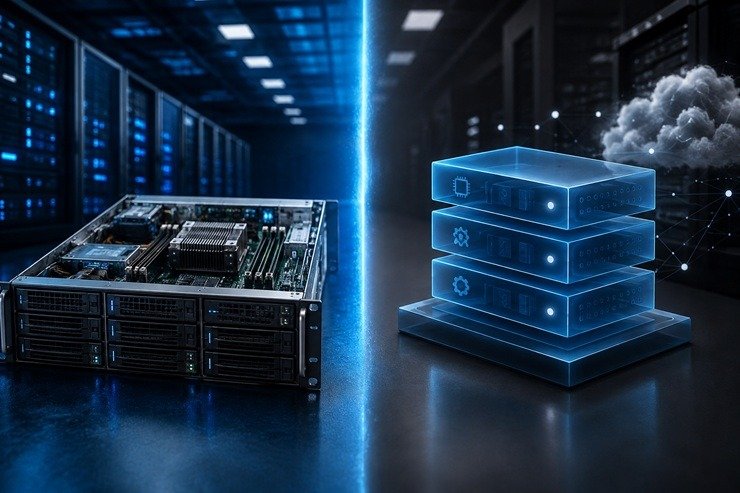
Choosing the right server infrastructure can be surprisingly difficult. You may have a powerful physical server on one side, offering complete access to its hardware, while on the other you have a Virtual Dedicated Server that can be deployed in minutes, scaled more easily, and usually costs considerably less.
So which option actually makes more sense for your workload?
The choice is somewhat similar to deciding between owning a high-performance car and using a flexible vehicle service. A dedicated physical machine gives you complete control over the hardware and its resources. A VDS, on the other hand, provides greater flexibility and makes it much easier to adapt your infrastructure when requirements change.
Instead of focusing only on advertised CPU cores, RAM capacity, or monthly prices, it is worth looking at how both technologies behave under real production workloads.
Bare Metal vs. VDS: Understanding the Fundamental Difference
Before comparing performance and pricing, it is important to understand what you are actually renting or controlling in each environment.
Think of a modern residential complex.
A Virtual Dedicated Server (VDS) is similar to having a premium apartment inside that building. Your virtual machine has its own allocated resources, its own operating system, and an isolated environment. Other tenants cannot directly access your instance. However, the underlying physical infrastructure is still shared. The host server, hardware controllers, and virtualization layer are responsible for running multiple virtual environments.
A Bare Metal Server is closer to owning the entire building yourself.
The physical machine is dedicated exclusively to your workloads. There is no hypervisor sitting between your operating system and the underlying hardware in the same way there is with a conventional VDS deployment. CPU cores, RAM, storage controllers, PCIe resources, and other hardware components are available to your applications without competition from neighboring virtual machines.
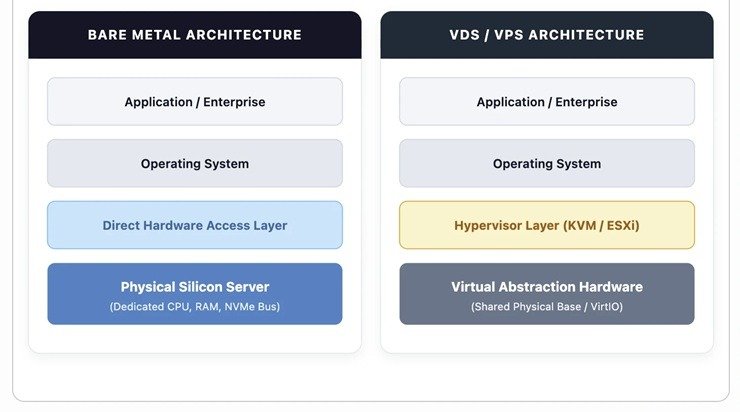
The key trade-off: Bare Metal provides maximum hardware control, predictable performance, and complete physical isolation. VDS focuses on rapid deployment, flexible resource management, convenient snapshots, and lower entry costs.
Performance: Does Virtualization Really Matter?
A common question is whether the virtualization layer creates a meaningful performance penalty in modern production environments.
The answer depends heavily on the workload.
Modern hypervisors such as KVM and VMware ESXi are highly optimized. For many conventional CPU-intensive workloads, a properly configured VDS can operate with only a small amount of virtualization overhead. In typical web applications, Node.js services, business platforms, or online stores, the practical difference may be difficult to notice.
The situation becomes more interesting when an application depends heavily on storage I/O, memory bandwidth, or extremely consistent latency.
On a physical server, the operating system communicates directly with the storage hardware and its controllers. In a virtualized environment, I/O requests pass through a virtualized device layer, such as virtio, before reaching the physical hardware underneath the hypervisor.
Under heavy load, this additional layer can sometimes contribute to latency variability. A database operation that normally completes in a few milliseconds may occasionally take significantly longer when the underlying infrastructure is congested. For a standard website, this may have little practical impact. For financial transaction systems, real-time advertising platforms, high-frequency processing, or latency-sensitive gaming infrastructure, however, even relatively small variations can become important.
Flexibility vs. Control: What Happens in Everyday Operations?
Raw performance is only one part of the decision. The way you manage and scale the infrastructure can be equally important.
Imagine that it is Friday afternoon and an unexpected marketing campaign suddenly takes off. Within twenty minutes, website traffic increases by 400%.
With a VDS, increasing available resources is generally straightforward. Depending on the hosting provider, you can change the amount of RAM or vCPU assigned to the instance through a control panel or API. If your infrastructure is managed through Infrastructure as Code and tools such as Terraform, many scaling operations can also be automated.
A physical server cannot be expanded quite so quickly.
If the existing machine is already using all of its available resources, you generally have several options:
- Optimize the application and reduce unnecessary CPU, memory, or database consumption.
- Deploy an additional physical server and distribute the workload between multiple nodes.
- Schedule a hardware upgrade and have additional components installed in the server.
All of these approaches require more planning and time than simply changing the configuration of a virtual instance.
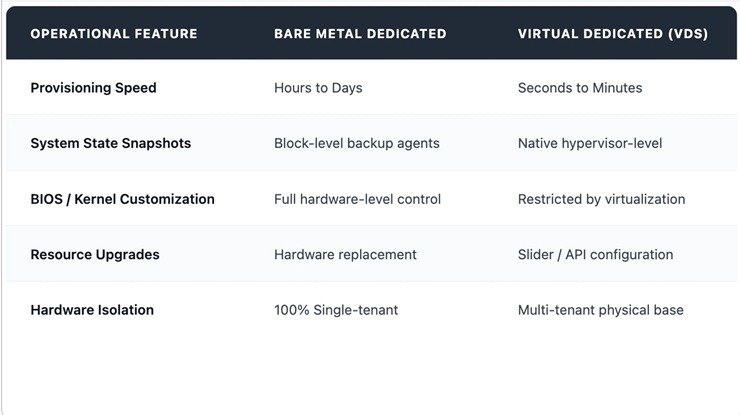
| Operational Feature | Bare Metal Dedicated | Virtual Dedicated (VDS) |
|---|---|---|
| Provisioning Speed | Hours to Days | Seconds to Minutes |
| System Snapshots | Backup software or agents | Native hypervisor-level snapshots |
| BIOS / Kernel Customization | Full hardware-level control | Limited by virtualization |
| Resource Expansion | Hardware upgrade or replacement | Configuration through panel or API |
| Hardware Isolation | 100% dedicated physical resources | Shared physical host |
Cost: Why the Cheapest Option Is Not Always the Most Economical
Price is often the strongest argument for choosing a VDS. At first glance, the difference can be substantial. A capable virtual server may cost around $40–80 per month, while a powerful Bare Metal configuration can easily reach $200–500 or more per month.
Does that automatically make VDS the better financial decision?
Not necessarily.
The economics depend heavily on how consistently you use the available resources.
If a server typically operates at only 10–30% utilization — for example, in a development, staging, testing, or internal business environment — paying for an entire physical machine may not be particularly efficient. A large portion of the available computing capacity could remain unused most of the time.
The calculation changes when the workload remains high around the clock. If a production application consistently uses 70% or more of the available CPU capacity, a dedicated physical server can become more attractive in terms of performance per dollar and overall infrastructure cost.
When you order a VDS with a large amount of vCPU and RAM, the provider must reserve a corresponding share of resources on the physical host. At a certain scale, using an entire physical server can provide substantially more raw processing capacity, storage performance, and dedicated resources for the money.
How to Choose: A Practical Decision Guide
Rather than choosing a server based solely on specifications, start with the actual requirements of your application.
Bare Metal is the better choice when:
- You operate demanding database workloads: PostgreSQL, MySQL, ClickHouse, MongoDB, and similar systems can benefit from high storage performance, large numbers of I/O operations, and consistently low latency.
- Your project requires strict infrastructure isolation: Some regulated environments require physically dedicated hardware and tighter control over the complete server stack.
- You need GPUs for AI or machine learning: Model training, LLM workloads, and CUDA-intensive applications may benefit from direct access to dedicated hardware accelerators and high-performance PCIe resources.
- Your utilization is consistently high: You understand your resource requirements well and expect the server to remain heavily loaded for long periods.
A VDS is usually the better option when:
- Your workload changes frequently: E-commerce platforms, SaaS products, media websites, and other applications may experience sudden traffic increases and benefit from flexible resource scaling.
- Fast recovery is important: Hypervisor-level snapshots make it possible to preserve the state of a virtual machine and quickly restore it after an unsuccessful deployment or configuration change.
- You use microservices or Kubernetes: Virtual nodes are convenient for automated environments where servers are regularly created, tested, scaled, and removed through scripts and CI/CD pipelines.
- You are launching a new project: A VDS provides access to a stable server environment without requiring a large commitment to physical hardware from day one.
The Hybrid Model: Why Choose Only One?
In many real-world architectures, there is no reason to limit yourself to either Bare Metal or VDS.
A hybrid infrastructure can combine the strengths of both approaches. For example, a primary database with demanding I/O requirements can run on a powerful Bare Metal dedicated server, while web servers, APIs, microservices, and background workers operate on flexible VDS instances.
The physical server handles workloads where consistent performance is the priority, while the virtual infrastructure provides the scalability and operational flexibility needed by the rest of the application.
For larger systems, this approach can provide a practical balance between performance, scalability, and infrastructure costs.
Final Thoughts: Choose Based on Workload, Not Marketing
There is no universal winner in the Bare Metal versus VDS debate. The right choice depends on how your application behaves, how predictable the workload is, and how much flexibility your infrastructure needs.
Before making the decision, examine your actual metrics. Look at CPU utilization, memory consumption, storage latency, I/O activity, traffic patterns, and how frequently your infrastructure needs to be resized.
If your application consistently requires maximum physical performance and you have a stable, predictable workload, Bare Metal may be the right solution. If rapid deployment, flexible scaling, automation, and easy recovery are more important, a properly configured VDS is likely to be the more practical choice.
And when your architecture requires both high performance and operational flexibility, a hybrid approach can give you the advantages of both environments without forcing you to compromise where it matters most.














Bare Metal vs VDS: Which Server Is Right for Your Project?

How to Create Professional Training Manuals In-House

How to Start Exercising Again Without Aggravating an Old Injury

7 Costs People Forget to Budget for When Moving Overseas

Creating a Life That Feels Right: How Your Home Can Reflect the Life You Truly Want

A Simple Money System For Small Businesses: Cash Flow, Payments, And Access

How to Create Presentations That People Understand and Remember

Why Personalized Gifts Are Replacing Traditional Gift Ideas

Why Natural Diamonds Continue to Define Modern Luxury

Understanding the Intricacies of Social Security Benefits

100 Motivational Quotes to Inspire You in 2026

How to Create a Vision Board That Actually Works (2026)

22 Best Self-Help Books to Read in 2026

How to Achieve Personal Growth in 2026

New Year Wishes and Quotes to Inspire and Celebrate (2026)

Loeb Smith reviews: Why Crypto Licensing Demands Patience, Structure, and Skepticism

Custom Cover Letter Generator: Create Tailored Letters in Minutes

Beyond the Shore: The Coolest Boat Trips Around the World

How to Leverage Personal Development for Career Advancement

Top Fitness Coach Certification Programs for Aspiring Trainers
-

 Motivation6 years ago
4 Fun New Hobbies To Try This Year
-

 Quotes3 years ago
53 Motivational Gym Quotes to Fuel Gym Workout
-

 Quotes11 years ago
50 Most Powerful Quotes Ever Spoken
-

 Travel2 years ago
Why You Should Travel More: The Many Benefits of Seeing the World
-
 Quotes8 months ago
100 Motivational Quotes to Inspire You in 2026
-

 Quotes2 years ago
43 Inspirational Quotes About Thoughts
-

 Quotes4 years ago
Motivational Quotes by Famous People
-

 Quotes1 year ago
100 Motivational Quotes to Start Your Day with Positivity